

NatGeo’s GENIUS: MLK/X
I had the pleasure of speaking with the incredibly talented cast and the Executive Producers of the EMMY® AWARD-WINNING ANTHOLOGY SERIES, GENIUS: MLK/X. Tune in as Aaron Pierre (Malcolm X) and Kelvin Harrison Jr. (Dr. Martin Luther King Jr.) discuss playing such incredibly important historical figures and how they prepared for the ultimate experience they were both honored to embark on. Weruche Opia (Coretta Scott King) and Jayme Lawson (Betty Shabazz) also join me for a conversation about portraying the very beautiful, strong, and independent wives who were at the forefront. Then Executive Producers Reggie Rock Bythewood and Gina Prince- Bythewood talk about what makes this series like nothing you’ve seen before and taking on such an important project.
GENIUS: MLK/X Stars Kelvin Harrison Jr. (‘The Trial of the Chicago 7’) as Dr. Martin Luther King Jr., Aaron Pierre (‘The Underground Railroad’) as Malcolm X, Weruche Opia (‘I May Destroy You’) as Coretta Scott King, and Jayme Lawson (‘The Batman’) as Betty Shabazz The Series Also Marks One of the Last Roles for Emmy-Winning Actor Ron Cephas Jones (‘This is Us’)

GENIUS: MLK/X follows both Dr. Martin Luther King Jr. (Kelvin Harrison, Jr.) and Malcom X (Aaron Pierre) from their formative years, where they were molded by strong fathers and traumatic injustices, to their rich, parallel stories as they shaped their identities and became the change they wished to see in the world.
The docu-drama series offers an intimate look into their complex lives as husbands, fathers, brothers and sons, taking them off the iconic T-shirts to show their humanity. GENIUS: MLK/X brings their wives, Coretta Scott King (Weruche Opia) and Betty Shabazz (Jayme Lawson), who are often portrayed as peripheral figures, to the forefront and shows them as formidable equals of the Movement.
Episodes will explore the moments between the monumental historical events we’ve come to know and shine a light on how each leader and those closest to them questioned their resolve and decisions as they navigated the rigors of balancing a public persona with a private life.
While King and X met only once and often challenged each other’s views, neither would have been as successful without the other.
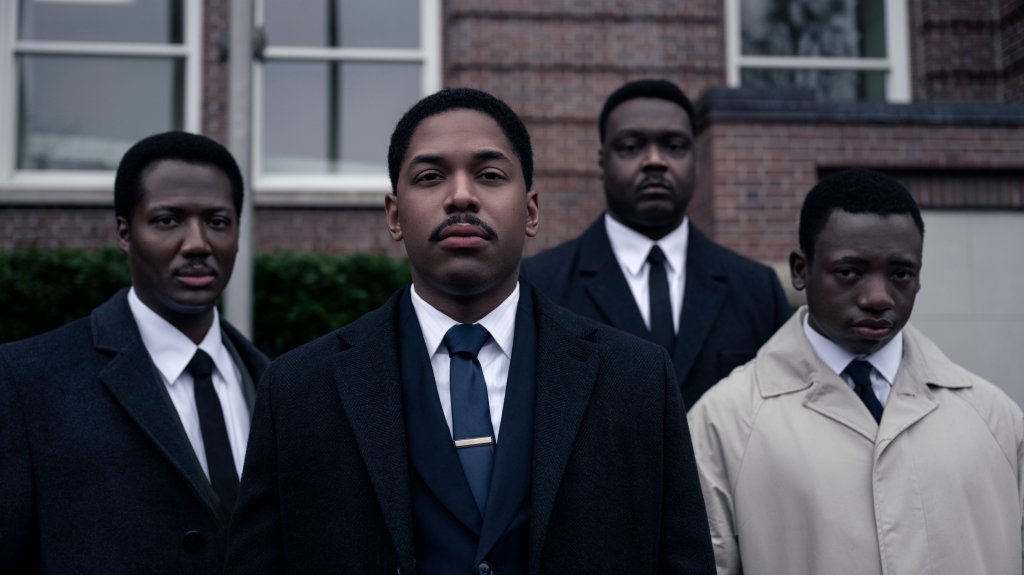
Aaron Pierre (Malcolm X) + Kelvin Harrison Jr. (Dr. Martin Luther King)
Congrats on the series. First, I wanna say, amazing job. From everything down to, like, the mannerisms you guys both got it down packed. How is it playing such incredibly important historical figures? And, what kind of preparation did it take to, like, embody them? Like I said, like the mannerisms and the speech, um, kind of, how was it playing these characters?
(Aaron) 00:27
It, it was, it was, it was a wonderful experience. You know, it’s something that I feel deeply privileged and honored to have had the opportunity to embark on.
00:36
You know, it was, um, you know, we, we said many times today, you know, it was, you know, of course, at the very beginning.
00:41
You do, you do the essential, the essential, deep dive and exploration of the text.
00:47
You know, you, you read the autobiography. You read The Sword and the Shield by panel E joe’s.
00:53
If you watch a documentary that is guided and and and helmed by Doctor Betty, she bears you.
00:58
You watch footage, you know, interviews, university lectures, panels, speeches. You, you watch all of this stuff.
01:06
And you, and you, you go to, you know, as much as you, you are afforded the time and the luxury to, you go to these places that they, they existed, and they walked, and they breathe.
01:14
They lived. They led in. You know, I had the opportunity to go to New York to spend time in Harlem, and it was a beautiful experience.
01:21
You know, I-I love harlem deeply i love new. York deeply To be there and be inspired and empowered by the environment was a beautiful experience and then you know when it comes to the mannerisms and things you know you we worked with a dialect coach um, you know, we lost and gained weight.
01:38
You know, and, and we, if we work out what it is to to, to sustain that for six months in a healthy way, you know, as best we can we, you know, for me personally, I-I-I-I-I-I-I was in his mannerism so much that after the fact when we wrapped i had to relearn my.
01:55
Own mannerisms because I was still doing things. I was like, that’s Malcolm, that’s, that’s, that’s not me.
02:01
You know. I had to relearn myself in regards to my nuances, at least, and my mannerisms, um.
02:08
But it was a beautiful experience, one that I would do all over again, and it was just an honor and a privilege to be of service to him.
(Kelvin) 02:15
One of my favorite moments in this show too is when we all when we come back after the meeting, and we both sit down and are like respective homes, and we’re like, how was meeting him?
02:25
And he was like, he was skinny.
02:29
Oh my God.
02:31
Anyway, sorry, I guess.
How do both of you work on, like, developing accents for, for these specific roles? Because their accents are very different.
(Kelvin)
Oh, that’s true. Um, you know, we, like Aaron, said we work with a dialogue coach.
02:49
And I think if you start pulling clips that from the different years, and, and the hardest part is actually finding stuff from the earlier years.
02:56
So I was pulling stuff from the like, when he was a teenager and trying to see what that sounded like, because he really started to figure out what he wanted to sound like.
03:05
He went to seminary school, so I found his report card in one of the books, and he had this whole, like, orator, like, performance class, and he, he always scored really high in performance.
03:15
But when he came to like, research, it was like, not this good scores, um, I mean, to put his business out there, but, but, um, well, I guess who have wrote that book, put his business out there, um.
03:27
But I think, you know, you try to get, get a little bit from each period of time, and, you know, what you hear later on is a bit of a weathered sound, and there’s a little bit of exhaustion.
03:38
And he was also, you know, you know, he, he, he was eating a lot.
03:43
He was smoking, sometimes, he was drinking at times. he was too stressed.
03:46
And so, at all these different things that come with age and experience experimenting with, you know, the life of it all, kind of play into trying to find those little nuances to put into it, um.
03:56
And we would gonna, every episode would come down to be, like, two, three years.
04:00
So we, we had to be really specific about where we were and what part of who we were playing, it was at the time, what he looked like, what they felt like about him.
04:08
You know, it’s, it’s a lot, um, but I’m, I don’t know what your experience was.
(Aaron) 04:12
Yes, that was very similar, you know, working with a dialect coach.
04:16
And that’s, I think, that’s, that’s something that is really, um, it’s really nerve racking, you know, doing working with a dialect coach.
04:24
Because you’re working with someone whose life and expertise, area of expertise is how to phonetically break down any accent that exists.
04:34
And when you’re working with someone that is that tuned, that acutely aware, that aligned with this particular voice, it’s like a boot camp.
04:42
Oh, and I think as as as nerve racking as that is, it served us.
04:47
It only served us because we had six months of of of of doing this.
04:51
So I think that boot camp, of the voice, of the intonation of where my tongue places in order to say certain words was what and breath was was, was invaluable.
05:01
And we, and, you know, we’re deeply grateful to that department for that.
05:04
And lastly, for the both of you playing in roles like Aaron the Underground Railroad and Brother, which dealt with, like, themes of identity and masculinity, and Kelvin in um, cavalier Monster Trial Chicago Seven. Like, how do you guys go about taking such iconic roles and traumatic roles?
(Aaron) that’s really kind and thoughtful of you.
05:25
And I think, you know, um, I think the reason I do the work that I-I do and i choose TO do is because honestly, it comes from a deep love of my loved ones and my community, and wanting to tell stories that connect with them and celebrate and champion their experience and.
05:50
And explore their experience in all of its detail and nuance.
05:54
Um, so that is something that I will always do. I have always done, and, um, and, and I, and I feel privileged to be given the opportunities to do it.
06:03
Thank you so much, guys. This was amazing.
06:06
Sorry, I have to wrap. I wish I could talk to you guys for an hour.
06:10 Bye.


Weruche Opia (Coretta Scott King) + Jayme Lawson (Betty Shabazz)
Hi, ladies. How are you? Oh, how are you?
00:05
Good? I just wanna say both of you were incredible, and you brought a lot of joy to such a very different take on this, um, kind of, um, I guess, like themes. And Coretta and Betty are both very beautiful, strong, independent and their own individual. How do you think they battled against societal norms and dealt with such like racist and sexist laws of the time?
(Jayme) um, finding there, finding their pockets, right?
00:37
Finding their moments. I think, I think a lot of times that was even through their husbands, right?
00:44
Is, um, if Malcolm could see Betty, right, and see her fully as the woman that she was and found value in her Um, that gives her the courage to then sacrifice all that she has to sacrifice for him, to continue to be the face of the of a movement that he was UM.
01:04
And it’s not easy, It can’t possibly.
01:09
But they continued to find and have agency and fight for UM. Fight for their voice in their and their space, even to the point that, after their their their husbands are taken from them, right?
01:21
They are the ones that are solely responsible for continuing the legacies of their these men.
01:26
Um, and that’s only possible if these are women who know how to fight for agency and to make space for themselves in in the face of societal challenges.
01:35
(Weruche) Um, that’s good.
01:38
UM, I tend to, you’re very smart and pretty, but you want me to answer yes.
01:47
Um, a lot of what she said, um, into And I love that.
01:53
Actually, I never, I know, I don’t always think about that, but, you know, their husbands also empowered them, I think, to, you know, to to use their voices.
02:04
I mean, especially because their husbands would listen to them. They had husbands who did listen, who, you know, would take.
02:10
We’re accountable. These husbands were accountable to their wives. And so I luckily enough, and I think enough, they trusted their wives because the advice they were giving was sound, and they understood and saw the results of, you know, what they were contributing to.
02:27
I think it definitely was encouraging, and would have given them more, more of a push to keep going.
02:32
And like you said, all that they achieved even after their husbands were taken for them goes beyond the spoken this, the scope of just their husband supporting them.
02:41
They obviously had their own desires, had their own wants for the movement for, you know, social justice and all that stuff, um.
02:50
And so we see that these women were empowered and, and they chose to use their voice and kept going, even after, you know, their husbands exactly what taken they they had their own desire to do to do great as well.
03:04
And Weruche. You have a degree in drama and sociology. How do you think this kind of helps you as an actress and taking on such, like, incredibly layered and important roles?
(Weruche) 03:15
We love that question.
03:19
I actually, okay, so I really enjoyed sociology. I did a joint degree of drama and sociology.
03:26
I didn’t like drama so much because it was a bunch of old plays that I had to read.
03:31
And I our art is, is it subjective? Subjective? Yes, everyone has their own interpretation.
03:36
And so I felt it hard when I was being told that my interpretation of of something was wrong.
03:42
And so sociology, for me, was more enjoyable to understand the study of society and people, and, um, I found that very interesting.
03:51
And saying that now it definitely does play a part in my understanding of all the characters that I take a and especially something like this, talking about social justice and, you know, community at large.
04:05
It definitely probably plays a part. I never even thought of.
04:10
You just told me something about myself today, but, um, I would definitely say it.
04:15
It played A-A part um to satisfy A-A part of myself that’s interested in the study of humans and society.
04:27
Jayme you were in The Woman King, Till, The First Lady. Do you prefer taking on period pieces? And like such important historical roles?
(Jayme) It would seem that way wouldn’t it.
04:37
Ha, ha, ha. I love it. Like powerful. I know why I-I-I find myself SO blessed honestly and so privileged that in the in the beginning of my career to be able to to do such right um because it’s it’s a wonderful opportunity I-I pride myself in coming into this industry that i would i would tell the stories for my mother for my sister for my great grandma and for my niece.
05:06
Right? Like, that’s my audience. That’s who I care, whose opinions really matter to me.
05:13
And so I try to find roles and women, um, through which I can do that.
05:19
And it just so happens that in the beginning, it’s a lot of these historical figures, it’s a lot of these, um, powerful women.
05:27
But I think the, the thing that I’ve enjoyed with Doctor Betty Shabazz is we get to explore all the nuance behind the power, that she’s not just relegated to this stoic individual, but that we get to see the frailties and the questions and the insecurities and the the girlish moments in her and all of that is as valuable as the quiet power that that we know of her.
05:55 UM.
05:56
And so I-I-I just find myself really fortunate um to get to explore in that way with the roles I’ve been GIVEN
And we get to see like Coretta’s musical background and like, how full of life Betty is. How is the character like you and how’s the character different? And how is it kind of preparing, getting into, like, the fashion and the lingo?
06:19
How is the character like you, different. And what was it like getting into the character?
(Weruche) I mean, I-I really like Coretta I think she’s cute um because I, buy her fashion she you know was a put together woman she enjoyed the arts very much like myself she had a lot to say.
06:40
She didn’t suffer fools. And I found a lot of, um, a lot of reliability with that, and I was able to connect on that level.
06:49
She’s a woman of faith, so am I, um, that was a really strong thread between the both of us to give me some understanding about her and to just feel her out and, and, and show her in how I see her, my portrayal of her, um.
07:06
But I said that was much difference. I mean, the life she led was quite, quite an interesting one.
07:16
A lot of burdens, a lot of things going on. I think she was extremely strong, an extremely strong woman.
07:22
And, um, I just in, I’m just in awe of her, and I’m I-I don’t know how else to say that but you know she she she lived, her life and I’m in, awe of it mhm i um
(Jayme) for Me.
07:39
I, found a lot similar with Doctor Shabazz, which was a treat, um, to a, to a certain extent.
07:45 Um, just as far as the the need to be of use or to be of service like, I understand that.
07:53
I know what that means. I know what that looks like.
07:55
Um. And then, as far as differences, you know, I’m of a different faith than her, right?
08:00
So then, what is that to have to, um, present or come in in public?
08:06
Right? I can’t necessarily, um, there’s a certain level of reservation, as Doctor Betty Shabazz, as in, in the public eye, in the public view.
08:17
Um, especially when talking about crafting intimacy, intimacy and chemistry. Um, with Aaron, right?
08:24
They weren’t allowed to have physical touch, right? And so when you’re doing that whole courting process, and everything is reserved for just the eyes, right?
08:33
Things like that, where I’m like, oh no, I don’t know if I’ve ever just courted somebody with my eyes who said, no, you know.
08:41
And so having to really that was its own thing, and, and, and, and delve into that, um.
08:47
So there were, there were some differences, there were some similarities in in that way, um.
08:52
And, but the lingo, however, didn’t feel too too different.
08:57
(Weruche) I mean, apart from the accent, right?
09:00
But I watch so much American TV, I was like, this is natural, man.
09:06
It’s like my second, you know. But it was interesting to to, you know, to learn it, to hear the difference between it and, um, you rock it the language, because, you know, the language wasn’t that wild.
09:18
(Jayme) No, I think there’s a lot of that, um, respectability.
09:24 The.
09:28
It lingers throughout generations, especially if you’re around a lot of older black men and women.
09:33
It’s still very much So there you’re still raised in it.
09:36
And so it didn’t feel too different in that in that way.
09:39
We’ve got well spoken Moon, we do.
09:42
Thank you so much, ladies. This is great. Congrats on the series.
09:46
Thank you. Bye, bye.

3. Reggie Rock Bythewood (Executive Producer) + Gina Prince- Bythewood (Executive Producer)
Hi, how are you? Hi, Gina. Hi, Reggie. Hi Nadya. How are you doing good?
00:04
How are you really good? Thanks. I just wanna say, I think the series does a phenomenal job of showing us their lives outside of the public eye. And it really makes you cry. It makes you laugh. It makes you smile. You see them dancing. And like all these things you don’t typically see with these stories. Um, so how do you kind of go about telling, like, America’s, like, really dark history and relevance even today? And what inspired this series and exploring real life events and taking creative freedom?
(Reggie) um, well, you know, first of all, their humanity was essential to portray in this, this eight, hour film.
00:47
And, um, really wanna credit. Um, you know, my, my chief collaborated here, but as as well, we brought in, um amazing show runners and Rafael Jackson, Damien Macedon, and an amazing writing staff.
01:05
UM had an amazing think tank where we had activists and scholars, you know, come together and just spend hours and hours talking about Martin, Malcolm Correta and Betty.
01:20
And, you know, just out of all of this, really, um, put forth a narrative that just, um, gave us the humanity of these four icons and allowed us to see them not just as icons, but as, but as human beings.
01:40
And what was challenging about bringing the script to life and tackling such like traumatic historical moments, and what made you really want to be involved in this production?
01:50
(Gina) Um, since then, the NAT G-O first came to us and asked if we wanted to do the fourth season of genius about doctor King and While.
02:00
We thought that could be interesting we did immediately say to ourselves and then to NAT G-O can’t really have doctor King without Malcolm x, They’re both so integral not only to the movement but also to each other’s rise they fueled each other inspired, each other, and they both had the same goal.
02:19
They were just coming at it a little differently. And as they as their lives went on and closer to their deaths, they were more line than they were, um, apart.
02:28
So we really wanted to tell that story and change the narrative that you have to decide between one or the other.
02:35
And again, through that think tank, we learned so much about them and their wives, and it really started to tell us how we wanted to tell the story and in what elements.
02:46
But I think more than anything, that think tank we all know about the big, iconic historical moments.
02:52
We wanted to know what was happening behind those moments. We want to know what was happening in their lives.
02:57
Beyond being an icon, how are you as a father, as a husband, as a man, as a woman, struggling under such enormous pressure that so many of us can’t even fathom.
03:07
But we wanted to hopefully bring you into that. And as we’ve said, see their true humanity and their struggles and vulnerability, but also their fight and commitment and their joy, right?
03:17
(Reggie) And their joy and love and, and, and love and, and as challenging as that was, you know, pertaining to your question, you you know, it was also the fun part of the, the narratives.
03:31
You know, it was just like as an artist to really hold the mirror up to each other, and in his in turn, hold the mirror up to society.
03:39
Today was, was, was a great task, but it was something that everybody dug in for and, um, really allowed us to elevate this series.
03:51
I think that’s one of the things that I don’t know, definitely sets it apart from a lot of the things that we’ve seen before, like you exploring their love lives. And, like, martin actually has game like it was, it was pretty fun to watch. Um. So how do you think the series actually contributes to the larger conversation within the film industry, especially when it comes to themes of black trauma and not exploiting it? And how the film industry can continue to like STEM important conversations by showing us film like this and series like this.
(Reggie) 04:25
And I just think that this narrative is never intended to be a museum piece.
04:34
Is never intended to feel like that was then. And therefore we can just kind of sit back and not feel it’s relevant.
04:42
It’s so relevant and urgent, especially now, um, but we also love the fact that our, our actors are sort of young versions of Malcolm and Martin.
04:57
Martin, 26 years old when he led the Montgomery bus boycott.
05:01
You know, Kelvin Harrison, junior in his twenties, playing Martin. You know, like, we love casting a younger Malcolm, a younger Martin, younger Betty and Correta, and just reminding the audience that they were young, they were young when they really committed to a lot their lives of this movement.
05:21
And that feels fresh and hopefully inspiring to to young people today.
05:27
And how do you think the production is bringing something new to this story? What do you think the audience is gonna be talking about? And what’s gonna surprise people watching this?
05:37
(Gina) I mean, we hope we went into this thinking we knew a lot.
05:41
And during that thing, tank pretty blown away by the things we didn’t know, the things that surprised us, and that got us excited, because we knew then that we were gonna bring to an audience into the world aspects of their lives, that that people don’t know, and we’ll be relegatory.
05:58
So it’s hard because we don’t wanna give them away, um, here, because we want the audience to go on that journey and be surprised by by every moment.
06:07
I’ll just touch on one thing which was such a surprise me, and is, is not in anything I’ve ever learned, is that Malcolm X was at the March on Washington.
06:16
That was a stunning revelation to us. And then obviously we explore why he was there and at what point he was but things like that, which changed the
way we think about these iconic moments.
06:28
Um, you know, that that’s just a big part of our narrative.
06:33
Thank you so much for taking the time. Congrats on the series. It’s, it’s phenomenal. And I think a lot of people are gonna be talking about it.
06:40
We appreciate that. Thanks, Nadya.
GENIUS: MLK/X Premieres Feb. 1 on National Geographic and Streams Feb. 2 on Disney+ and Hulu; The Pilot Episode Will Simulcast on ABC Feb. 1 at 9/8c
Premiere: Feb. 1 at 9/8c on National Geographic and next day on Disney+ and Hulu (and continues with two episodes every week through the end of February).
#MLK #OfficialTrailer #NationalGeographic About National Geographic: National Geographic is the world’s premium destination for science, exploration, and adventure. Through their world-class scientists, photographers, journalists, and filmmakers, Nat Geo gets you closer to the stories that matter and past the edge of what’s possible. Get More National Geographic: Official Site: http://bit.ly/NatGeoOfficialSite
Episode List:
“GRADUATION” premieres Feb. 1 at 9/8c on Nat Geo. Streams Next Day on Disney+ and Hulu.
Young Martin is influenced by his family and the racial circumstances of the Jim Crow-era South. He developed community and leadership skills while attending and ultimately graduating from Boston University. Young Malcolm is taught racial pride, economic self-sufficiency and ultimately loss. As a young man, he succumbs to a life of vice and corruption. While incarcerated, he’s introduced to the Nation of Islam, eventually leaving prison with a new passion and purpose.
“WHO WE ARE” premieres Feb. 1 at 10/9c on Nat Geo. Streams Next Day on Disney+ and Hulu.
Martin and Malcolm each work to shape their identities and become the change they wish to see in the world. Martin takes a pastor position in Montgomery and marries Coretta Scott. Malcolm purges his past and devotes himself to the NOI, becoming the leader of the Harlem Temple.
“PROTECT US” premieres Feb. 8 at 9/8c on Nat Geo. Streams Next Day on Disney+ and Hulu.
Martin and Coretta begin their family as the Montgomery Bus Boycott propels MLK into national headlines as the leader of the Movement. Malcolm proposes to Betty Saunders as he ascends to become the National Representative of NOI.
“WATCH THE THRONE” premieres Feb. 8 at 10/9c on Nat Geo. Streams Next Day on Disney+ and Hulu.
As the president of SCLC, Martin struggles to find a balance between active and passive resistance, relying on his faith for guidance. Malcolm is absorbed in his work, which creates strife for Betty and challenges his relationship with Elijah Muhammad.
“MATRIARCHS” premieres Feb. 15 at 9/8c on Nat Geo. Streams Next Day on Disney+ and Hulu.
Pressures and expectations take a toll on Coretta and Betty. They each question their resolve and decisions as they navigate the rigors of a public persona and private life.
“THE AMERICAN PROMISE” premieres Feb. 15 at 10/9c on Nat Geo. Streams Next Day on Disney+ and Hulu.
Two monumental 1963 events—the March on Washington and the Kennedy assassination—have lasting effects on both men. Martin becomes the moral leader of the Movement, while Malcolm is suspended from the NOI.
“THE SWORD AND THE SHIELD” premieres Feb. 22 at 9/8c on Nat Geo. Streams Next Day on Disney+ and Hulu.
The two leaders meet briefly in DC while supporting the passage of the Civil Rights Act. Martin wins the Nobel Peace Prize. Malcolm forms two new organizations. Both men are under scrutiny and surveillance.
“CAN YOU IMAGINE” premieres Feb. 22 at 10/9c on Nat Geo. Streams Next Day on Disney+ and Hulu.
Malcolm’s fate is sealed after he criticizes the NOI. Martin’s political views lead to his ultimate sacrifice for the Movement. The two leaders are assassinated, but their legacies continue to inspire.
#interview #GeniusMLKX | #NatGeo


 Gotham Geek Girl